In 2005, your credit union chose a core processor. Maybe it was Symitar. Maybe it was GOLD. Maybe it was DNA. Whatever you picked, you locked in for fifteen years. The technology shaped your workflows, your data model, your vendor relationships, your hiring decisions, and your strategic options for a decade and a half. Most credit union CEOs I talk to will tell you that decision — made before the iPhone existed — still constrains what they can do today.
You’re about to make the same kind of decision about AI. And most of you don’t even know you’re making it.
The decision isn’t which chatbot vendor to buy. It isn’t whether to deploy AI this quarter or next. It’s an architectural choice that will determine whether the AI you invest in gets smarter every month or resets to zero every conversation. Stateful versus stateless. Persistent versus ephemeral. An agent that learns versus a tool that forgets.
Most credit unions have already chosen — by default, without realizing it. They chose stateless. And eighteen months from now, that choice will look exactly like picking the wrong core in 2005.
The Architecture Nobody Explained to You
Let me make this concrete, because the industry has done a terrible job explaining what’s actually happening under the hood.
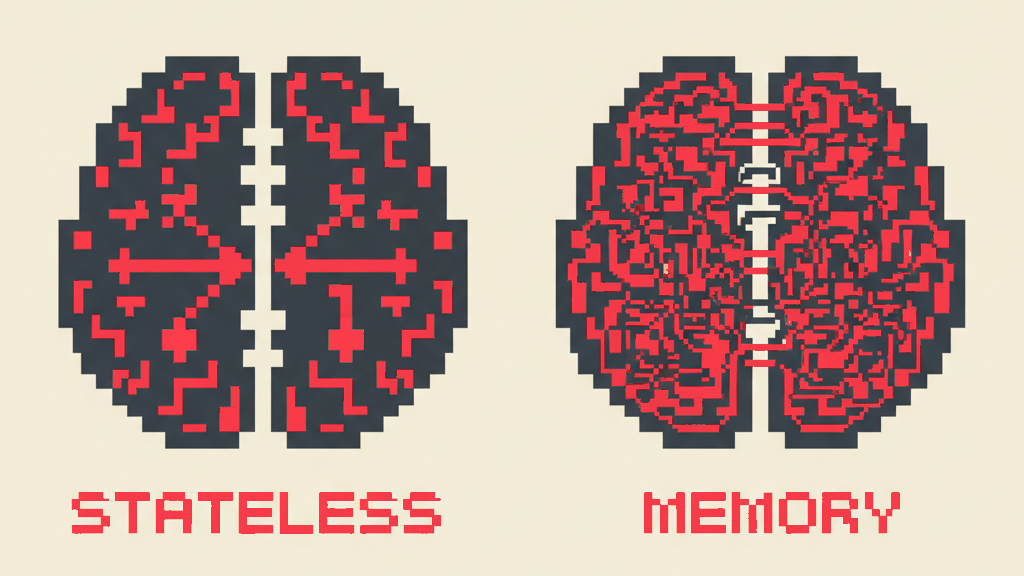
A stateless AI agent resets after every session. You ask it a question, it answers, and the conversation ends. Next time you interact, it has no memory of the previous exchange. No context. No accumulated knowledge. Every session starts from zero.
A stateful AI agent retains context across sessions. It remembers what happened last Tuesday. It knows that your BSA officer prefers narratives structured a certain way. It recalls that a specific alert rule generates 94% false positives at your institution because of your member demographics. It accumulates institutional knowledge over weeks, months, and years.
As one founder put it in a post that crystallized this distinction: “The architectural decision that separates these two worlds is simpler than most founders think: stateful vs. stateless agents. A stateless agent resets after every session — all that signal, discarded. A long-running agent retains it, learns from it, gets harder to replace every single week.”
That last part — gets harder to replace every single week — is the critical insight. A stateless tool has no switching cost because it has no accumulated value. A stateful agent becomes more valuable every day it operates, because it’s building an understanding of your institution that no fresh deployment can replicate.
Here’s the problem: every chatbot your credit union has deployed is stateless. Every copilot. Every “AI assistant” that answers member questions from a knowledge base. They process a query, return a response, and forget everything. The 58% of credit unions that have deployed a chatbot — the statistic I cited in Article 7 — have all deployed stateless AI. They made an architectural choice without knowing they were making one.
The Temp Agency Analogy
The simplest way to understand the difference: stateless AI is a temp worker. Stateful AI is a full-time hire.
I’ve seen this play out in the most literal sense. At one CUSO I worked with, they brought in temporary BSA analysts during exam season — contractors who’d arrive, ask the same questions every engagement, work through the alert queue without any institutional memory, and leave. The permanent staff spent as much time onboarding the temps as the temps spent doing useful work. Same ramp-up. Same ceiling on what they could accomplish, because they never accumulated the institutional knowledge that separates adequate from excellent.
That’s exactly what a stateless AI does. Every session, it shows up fresh. Where’s the bathroom? What’s the password? How does this system work? Who handles escalations?
Your full-time employee? After six months, they don’t just know the procedures — they know the exceptions. They know that Janet in accounting prefers email over Slack. They know that the third-Tuesday board report needs to include the liquidity ratio because Director Martinez always asks about it. They know that when the alert rule for structuring fires on accounts linked to the university payroll, it’s almost always a false positive because graduate stipends come in irregular amounts below the CTR threshold.
That’s not intelligence. It’s context. And context is what separates a tool from a teammate.
Now multiply that across every function in your credit union. A stateless BSA tool processes each alert in isolation. A stateful BSA agent knows that this member was flagged three months ago for the same pattern, that the investigation concluded it was legitimate business activity, and that reprocessing the same false positive wastes forty-five minutes of your analyst’s time. The stateless tool does the same work every time. The stateful agent does less unnecessary work every time — because it remembers.
The Hidden Cost of Forgetting
The real damage of stateless AI isn’t what it costs today. It’s what it costs eighteen months from now.
Consider two credit unions. Same size, same core processor, same market. Both deploy AI for BSA compliance in January 2026.
Credit Union A deploys a stateless compliance tool. It processes alerts using a general model, applies generic rules, and generates draft narratives. Each alert is processed independently. The tool doesn’t know that it processed the same member’s transaction last month. It doesn’t know that your examiner has specific documentation preferences. It doesn’t learn from your analyst’s corrections. Every alert is processed as if it’s the first one the system has ever seen.
Credit Union B deploys a stateful compliance agent. Same underlying model. Same initial capabilities. But by March, it has processed 400 alerts at this specific institution and knows that Rule 7 generates false positives at 3x the industry average because of the credit union’s military base membership. By June, it has learned your examiner’s documentation format from three rounds of feedback. By September, it’s surfacing patterns across alerts — “these three members showed coordinated activity that individually wouldn’t trigger a flag but collectively resembles layering.”
By December, Credit Union A has a slightly better chatbot. Credit Union B has a compliance analyst that knows their institution as well as a two-year employee — and is getting better every week.
The gap isn’t linear. It’s exponential. Each month of accumulated context makes the next month’s work faster, more accurate, and more insightful. The stateful agent in month twelve isn’t just twelve months better than it was in month one. It’s compoundingly better, because each insight builds on the foundation of every previous insight.
This is the flywheel I described in Article 18: better context produces smarter agents, which produce better outcomes, which earn more trust, which means more context shared, which produces even smarter agents. Stateless AI never enters that flywheel. It sits outside, processing each interaction in isolation, forever.
Why Most “AI” Is Stateless by Default
If stateful is so obviously better, why is everything your credit union has been sold stateless?
Three reasons.
First, stateless is easier to build. A stateless system processes a request and returns a response. No memory management, no context windows, no persistence layer, no vector indices, no knowledge graphs. Ship it, charge per seat, move on. Stateful AI requires an entire infrastructure layer — persistent storage, memory retrieval, context management, institutional knowledge indexing — that most vendors don’t have and don’t want to build. It’s the difference between building a search box and building a brain.
I know this because I’ve built both kinds of systems. At Flowroute, we built telecom infrastructure — the literal pipes that carry voice and messaging traffic. We could have built a stateless relay that processed each call without context. Instead, we built systems that accumulated routing intelligence over millions of calls. Infrastructure outlasts products. That conviction carried directly into how we architected Runline.
Second, stateless is easier to sell. “Try our AI chatbot — it answers member questions!” is a demo you can run in fifteen minutes. “Our AI agent will accumulate institutional knowledge over six months and become indispensable” is a pitch that requires patience, trust, and a fundamentally different sales cycle. Vendors optimize for the quick win. Credit unions, understandably, want to see results before committing. Stateless demos well. Stateful compounds.
Third, stateless avoids the hard problems. Memory management in AI is genuinely difficult. What should the agent remember? How long should it retain context? How do you prevent accumulated biases from compounding errors? How do you make institutional knowledge queryable without hallucinating? How do you give an examiner a clear audit trail of what the agent “knows” and why? These are hard engineering problems. Stateless vendors sidestep them entirely. Stateful vendors have to solve them — and the solutions become their moat.
I wrote in Article 5 that your core processor is a time capsule — decades of institutional data that nobody has unlocked. Stateless AI can’t unlock it, because stateless AI can’t learn from it. It can query it, sure. It can pull a transaction record and process it in isolation. But it can’t build an understanding of what 30 years of member behavior means for your institution specifically. That requires persistence. That requires state.
The Core Processor Parallel
In Article 5, I argued that your core processor — the thing everyone tells you is a liability — is actually your biggest strategic asset because of the decades of institutional data trapped inside it. The parallel to stateful AI is direct and worth spelling out.
Your core processor is, fundamentally, a stateful system. It maintains state across millions of transactions, across decades, across every member interaction your institution has ever had. That accumulated state — that institutional memory — is why core conversions are existential: you’re not just migrating software, you’re migrating thirty years of context.
I saw this at CU*Answers’ data center. Standing next to their IBM Power server — $5 million, 75 CPUs, processing for hundreds of credit unions — you feel the weight of institutional state. That machine doesn’t just store data. It holds three decades of member behavior, lending patterns, and operational knowledge. The physical mass of the thing is a metaphor for the switching cost: you can’t pick it up and carry it somewhere else.
Now imagine choosing a core processor that wiped its memory every night. Every morning, it starts fresh. No member history. No transaction records. No loan performance data. You’d never consider it. The idea is absurd. A core processor without persistent state is just a calculator.
And yet credit unions are deploying AI that does exactly this. Every chatbot, every session-based copilot, every AI tool that resets after each conversation — it’s a core processor that wipes itself nightly. The most important information infrastructure decision your institution makes about AI, and the default is amnesia.
The core processor decision in 2005 was a 15-year lock-in because of accumulated state — your data model, your workflows, your institutional processes all shaped around that specific system’s architecture. The AI architecture decision in 2026 will create the same kind of lock-in, but in reverse. The institution that chooses stateless will eventually need to migrate to stateful — and that migration will be as painful as a core conversion, because they’ll be starting the context accumulation from zero while competitors who chose stateful on day one have years of institutional intelligence already compounding.
What Stateful Architecture Actually Requires
I want to be honest about why this is hard, because if it were easy, everyone would do it.
Building a stateful AI agent for a regulated institution requires solving at least five hard problems simultaneously:
Persistent memory with selective retention. The agent can’t remember everything — that’s noise. It has to learn what matters: examiner preferences, institutional risk thresholds, member behavior patterns, seasonal workflows. This requires a memory architecture that includes not just storage but relevance scoring, decay functions, and importance weighting. Not all memories are equal.
Institutional knowledge indexing. Your SOPs, your policies, your communication templates, your examiner correspondence — all of this needs to be normalized, indexed, and made queryable. I described this in Article 9 as the “company context layer.” The context layer is what transforms a generic model into an agent that knows your institution. Stateless AI doesn’t need it. Stateful AI can’t function without it.
Audit-ready memory provenance. When an examiner asks why your AI agent made a specific recommendation, you need to trace the reasoning back through the agent’s accumulated context. “It learned this from processing 400 alerts” isn’t sufficient. You need to show which alerts, which corrections from your analyst, which policy documents informed the decision. Memory provenance is the compliance dimension of stateful AI, and it’s non-negotiable in regulated financial services. When your regulator can shut you down, you don’t bolt compliance on at the end. I learned that lesson building Concreit under SEC regulation, and it’s doubly true here.
Cross-session context synthesis. A stateful agent doesn’t just remember raw interactions. It synthesizes patterns across hundreds of sessions into institutional insights. “This type of transaction, from this type of member, in this seasonal window, historically resolves as legitimate” — that’s not a single memory. It’s a synthesis of dozens of data points across months of operation. Building the infrastructure for this synthesis is where most of the engineering complexity lives.
Isolation and data governance. Your stateful agent’s accumulated knowledge about your institution must be completely isolated from every other institution’s agent. Not logically separated in a shared database. Physically isolated. When your agent learns that your examiner prefers a specific SAR narrative format, that knowledge cannot leak to another credit union’s agent. I described the six-layer isolation architecture in Article 18 — code, credential, data, event, kill-switch, and retention isolation. Stateful AI without rigorous isolation is a compliance nightmare.
At Runline, we run on our own platform — five named AI agents (Woz, Ada, Byron, Linus, and Emila) operating inside our own infrastructure daily. We’re not theorizing about what stateful architecture requires. We’re debugging it at 2am when a memory retrieval query returns stale context. That’s the difference between selling a vision and building infrastructure.
This is hard. It requires a fundamentally different architecture than bolting a chatbot onto a website. But the institutions that invest in this architecture now will have something their competitors can’t buy off the shelf: an AI that genuinely knows their institution.
The Decision You’re Actually Making
Every credit union leader I talk to asks the same question about AI: “What should we buy?” The better question is: “What kind of AI architecture are we committing to?”
The stateless path is the path of least resistance. It demos well, deploys fast, and produces immediate — if modest — results. The vendor sells you a product, you plug it in, your members get slightly better service, your board sees an “AI initiative” in the strategic plan. Mission accomplished.
The stateful path is harder upfront. It requires infrastructure investment, patience during the ramp-up period, and trust that the compounding effect will materialize. Your agents aren’t impressive in month one. By month six, they’re doing things no stateless tool can match. By month twelve, they’re an extension of your team’s expertise. I watched this happen at Heartland Credit Union — the early weeks were unremarkable, but by month six the BSA Runner was catching patterns their veteran analysts had missed.
This is the same pattern as every infrastructure-versus-interface decision in technology history. In Article 7, I cited the Bezos API mandate and the Stripe-versus-Square parallel. Infrastructure is invisible and boring until it becomes indispensable. Interfaces are visible and exciting until they become commoditized. Stateless AI is an interface. Stateful AI is infrastructure.
I’ll quote the same founder whose tweet crystallized the architectural divide: a stateful agent “gets harder to replace every single week.” That’s not vendor lock-in. That’s value accumulation. The switching cost isn’t contractual — it’s contextual. You stay not because you can’t leave, but because leaving means abandoning months or years of institutional intelligence that no fresh deployment can replicate.
The Window Is Open — But Not Forever
The 18-month window I described in Article 16 applies with particular force to this architectural decision. Every month you run stateless AI is a month of institutional learning you don’t get back. The credit union that deploys stateful agents today and the one that deploys them in 2028 will have the same underlying model capabilities. But the first institution will have two years of accumulated institutional context. The second will start from zero.
Context compounds. Forgetting doesn’t.
Your core processor decision in 2005 shaped the next fifteen years of your institution’s technology trajectory. Your AI architecture decision in 2026 will shape the next fifteen years of your institution’s operational capability. The only difference is that in 2005, you knew you were making a generational choice. In 2026, most credit union leaders don’t realize the choice exists.
Now you do.
Stateless is the chatbot that forgets. Stateful is the agent that learns. One is a feature. The other is infrastructure. The decision between them is the most important technical choice credit union leaders will make about AI — and the industry that sold you the chatbot never bothered to explain the difference.
Don’t make the 2005 mistake again.
Sean Hsieh is the Founder & CEO of Runline, the secure agentic platform for credit unions. Previously, he co-founded Flowroute (acquired by Intrado, 2018) and Concreit, an SEC-regulated WealthTech platform managing real securities under dual federal regulatory frameworks.
Next in the series: “Stop Buying Tools. Start Buying Outcomes.” — for every dollar credit unions spend on software, six go to services. Sequoia Capital calls this the copilot-to-autopilot shift: the next trillion-dollar company will sell the work, not the tool. Here’s what that means for your credit union.