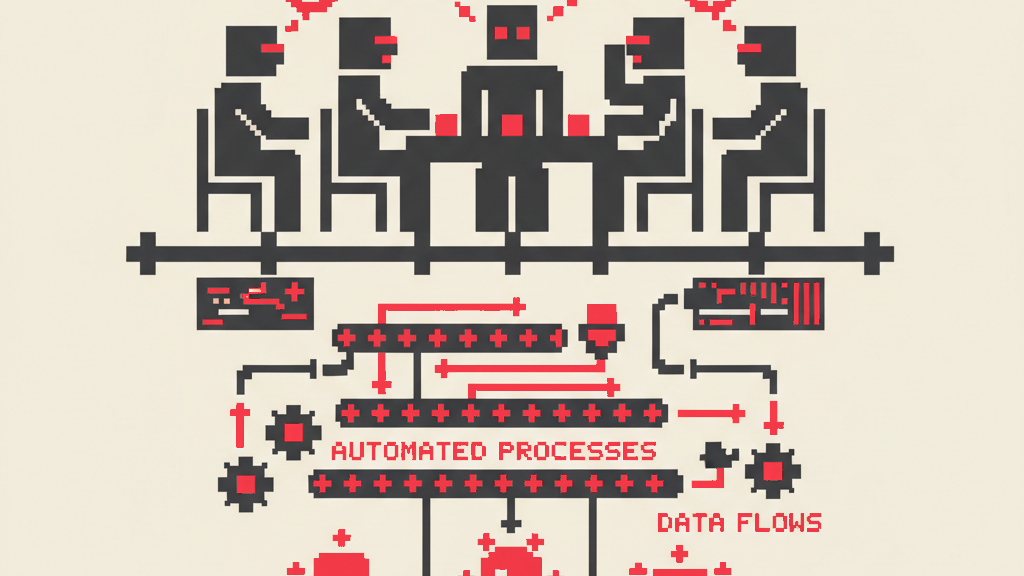
For every dollar your credit union spends on software, six dollars go to services.
Not six dollars on better software. Six dollars on human labor — outsourced compliance reviews, staffing agency temps for BSA during exam season, third-party loan doc prep, managed IT services, consulting engagements that produce a PDF and a handshake. The ratio comes from Sequoia Capital’s analysis of enterprise spending, and it holds across financial services with striking consistency: the labor market dwarfs the software market by 6:1.
Credit union leaders know this intuitively. You budget $400,000 for your compliance platform and $2.4 million for the people who operate it. You spend $150,000 on your loan origination system and nearly $1 million on the underwriters, processors, and closers who push applications through it. The software is the tool. The services are the work. And you’ve been buying both separately — the tool from a vendor, the work from your staff or an outsourcer — because until now, those were the only options.
That’s about to change. And the change will be more disruptive than the SaaSPocalypse I described in Article 4 — because this time, it’s not the software budgets at risk. It’s the services budgets. The ones that are six times larger.
The Copilot Trap
Julien Bek, writing for Sequoia Capital in a piece that earned 646,000 impressions and 5,200 bookmarks, drew a distinction that should reframe how every credit union leader thinks about AI:
Copilots sell the tool. Autopilots sell the work.
A copilot makes your employee more productive. It sits alongside your BSA analyst and helps them triage alerts faster. It assists your underwriter in pulling data. It suggests language for your member communications. The value proposition is amplification: same human, better tools, incrementally more output.
An autopilot does the work. It triages the BSA alerts. It assembles the loan package. It completes the vendor due diligence review. The human isn’t using a tool — the human is reviewing output, making judgment calls, and handling the exceptions that require genuine expertise.
I’ve seen the difference play out in real time. At one credit union partner, I watched their lending team — 11 loan processors touching five to seven systems per loan, triple manual data entry. A copilot makes each of those processors 20% faster. An autopilot assembles the entire package and presents it to an underwriter for review. Same outcome. Fundamentally different economics.
The distinction matters because of what happens to the vendor’s economics. If you sell the tool — the copilot — you’re in a race against the model. Every time the underlying AI improves, your tool becomes more commoditized. Microsoft Copilot at $30 per seat per month is a copilot. When the next model makes every copilot 2x better, the differentiation between copilot vendors collapses. You’re selling a commodity with a shrinking moat.
But if you sell the work — the autopilot — every improvement in the model makes your service faster, cheaper, and harder to compete with. The model gets smarter? Your BSA triage gets more accurate. Context windows get larger? Your loan document assembly handles more complex packages. Reasoning improves? Your vendor due diligence catches more risk signals. The vendor and the customer are on the same side of the improvement curve.
As Bek put it: “The next $1T company will be a software company masquerading as a services firm.” Not a services firm using software. A software company that delivers outcomes so reliably that the customer experiences it as a service.
Credit unions already understand this model. You just call it something different.
You Already Buy Outcomes — You Just Pay Human Rates
Here’s what credit union leaders rarely recognize: you’re already buying outcomes when you outsource.
When you hire a third-party BSA firm to handle your compliance monitoring during exam season, you’re not buying a tool. You’re buying a completed exam with clean findings. You pay for the outcome — successful regulatory compliance — and the vendor figures out how to deliver it.
When you contract with a CUSO for loan participation servicing, you’re not buying software. You’re buying serviced loans. The CUSO handles the collections, the remittances, the investor reporting. You pay for the work done, not the tools used.
When you engage a managed IT provider, you’re not buying a dashboard. You’re buying uptime. You’re buying patched systems, monitored networks, resolved tickets. The provider’s SLA is an outcome guarantee: 99.9% uptime, 4-hour response time, 24-hour resolution.
When you bring in a consulting firm for a strategic plan, you’re not buying their methodology. You’re buying a deliverable — a document that tells your board where to go next.
In every case, the credit union is already comfortable paying for outcomes. The friction isn’t conceptual. It’s that the outcomes have always been delivered by human labor — at human rates, on human timelines, with human capacity constraints.
AI changes the delivery mechanism. Not the model. The model is already outcome-based. The delivery is what shifts — from a team of five consultants working three months to an AI agent working three days, with a human expert reviewing the output and handling the judgment calls.
Intelligence vs. Judgment: The Spectrum That Matters
Not all work is created equal. Bek’s Sequoia piece draws a critical distinction between intelligence work and judgment work — and it maps perfectly to credit union operations.
Intelligence work is rules-based, pattern-matching, data-intensive. It follows established procedures. The right answer exists and can be derived from available information. It requires thoroughness, accuracy, and consistency — but not creativity or ethical reasoning. Most of the time, a well-trained junior employee can do it.
Judgment work requires weighing competing priorities, applying ethical frameworks, navigating ambiguity, managing relationships, and making decisions where the “right answer” depends on context that can’t be fully specified in advance. It requires experience, wisdom, and institutional trust.
I want to pull back the curtain here, because I’ve watched this split play out at every credit union I’ve embedded with. At Heartland, I watched Kari processing five to ten employment verifications per week at 15-30 minutes each. Pull the records, validate the data, generate the letter, send it off. Pure intelligence work. Zero judgment required. Fifteen feet away, the BSA team was making genuinely hard calls about whether a transaction pattern constituted suspicious activity — weighing member history, community context, regulatory guidance. That’s judgment work. Same department. Completely different cognitive demands.
Now map that distinction across your credit union:
Intelligence work (rules-based, automatable today):
- Triaging BSA alerts against known patterns — the 95% that are false positives
- Assembling loan packages from submitted documents
- Processing employment verification requests
- Researching member history before collections calls
- Generating routine compliance reports
- Classifying vendor risk based on questionnaire responses
- Reconciling transaction records across systems
- Drafting initial SAR narratives from alert data
Judgment work (requires human expertise):
- Deciding whether an unusual transaction pattern constitutes genuine suspicious activity
- Making credit exceptions for members with complex financial situations
- Negotiating payment plans with distressed borrowers
- Setting institutional risk appetite and policy thresholds
- Managing examiner relationships during supervisory reviews
- Coaching staff through complex member situations
- Strategic planning and competitive positioning
The uncomfortable truth: the vast majority of back-office credit union work is intelligence work. Your BSA analyst spends 80% of their time on mechanical triage and 20% on the judgment calls that actually require their expertise. Your loan processor spends 75% of their time on document assembly and data validation and 25% on the exception handling that requires institutional knowledge. At one CUSO I worked with, their BSA analysts were running at 125% capacity, averaging 60-hour weeks — not because the judgment calls were overwhelming, but because the intelligence work was burying them.
AI has crossed the threshold for intelligence work. It can triage BSA alerts with 95%+ accuracy on false positive identification. It can assemble a loan package from submitted documents in minutes instead of hours. It can research a member’s complete history across systems faster than any human can toggle between six vendor UIs. It can draft a SAR narrative that your compliance officer reviews and refines rather than writes from scratch.
The work is automatable. The question is who automates it — and how they charge.
The Autopilot Wedge: Start Where Work Is Already Outsourced
Bek’s Sequoia piece offers a tactical insight that’s particularly relevant for credit unions: the autopilot wedge starts where work is already outsourced.
The logic is simple. Outsourced work is the lowest-resistance entry point for AI-delivered outcomes because:
The budget already exists. You’re already paying for the outcome. The conversation isn’t “should we spend money on this?” — it’s “can we get the same outcome for less?”
The quality bar is already defined. When you outsource BSA monitoring, you have an SLA. When you use a staffing agency for seasonal help, you have performance expectations. The benchmark isn’t ambiguous. AI either meets it or doesn’t.
The institutional politics are minimal. Nobody’s job is threatened because nobody internal is doing the work. The outsourced compliance review isn’t displacing your compliance officer — it’s replacing the third-party firm that charges $150,000 per engagement. Your staff doesn’t feel threatened. They feel supported.
The comparison is direct. Third-party BSA review: $125,000 per year, 6-week turnaround, limited to the scope defined in the engagement letter. AI-delivered BSA triage: $35,000 per year, continuous monitoring, comprehensive coverage. The CFO comparison is instant.
In credit union world, the outsourcing landscape is substantial:
- CUSO compliance services — BSA monitoring, exam prep, regulatory reporting
- Third-party loan review — participation servicing, portfolio stress testing, QC sampling
- Staffing agencies — seasonal BSA analysts, temporary member service reps, interim IT support
- Managed IT services — network monitoring, security operations, helpdesk
- Consulting engagements — strategic plans, technology assessments, vendor evaluations
- Collection agencies — outsourced recovery on charged-off accounts
- HR outsourcing — benefits administration, employment verifications, payroll processing
Every one of these is an outcome the credit union is already paying for. Every one is predominantly intelligence work. Every one is a candidate for AI-delivered outcomes at a fraction of the human-labor cost.
Start there. Not because member-facing AI isn’t important — it is — but because the outsourced work is where the economic case is clearest, the institutional resistance is lowest, and the risk profile is most manageable. This is the same sequencing argument I made in Article 7: infrastructure first, interface second. The autopilot wedge is the operational version of that principle.
The $1:$6 Math in Practice
Let me make the economics concrete with four credit union functions.
BSA/AML Compliance. A mid-size credit union spends approximately $23 per alert on manual triage — analyst time, system costs, documentation overhead. At 400 alerts per month, that’s $110,000 per year just on triage, not including SAR preparation, exam support, or regulatory reporting. The outsourced alternative — a third-party BSA firm — runs $100,000-$175,000 annually.
An autopilot BSA agent triages alerts continuously, drafts SAR narratives, and presents completed investigations to your compliance officer for review and filing. The agent handles the intelligence work — the 95% false positive identification, the transaction pattern analysis, the narrative drafting. Your compliance officer handles the judgment work — the final determination, the examiner relationship, the policy decisions. Cost: a fraction of either the internal labor or the outsourced alternative. Outcome: same or better, because the agent processes every alert with full context rather than sampling.
Loan Document Preparation. The MBA benchmarks loan origination cost at $11,000 per loan. A significant portion of that is document assembly — income verification, employment confirmation, title searches, insurance verification, compliance checks, disclosure generation. A loan processor handles 15-20 files per month. A mid-size credit union with $200 million in annual originations processes roughly 800 loans per year.
An autopilot lending agent assembles the complete loan package — pulling and verifying documents, running compliance checks, generating disclosures, flagging exceptions. Your underwriter reviews a completed package instead of building one from scratch. The intelligence work is automated. The judgment work — credit exceptions, relationship lending decisions, policy interpretation — stays with your best people. That’s not a demo scenario. That’s a Tuesday.
Employment Verifications. I described this in Article 7: at Heartland, Kari was processing five to ten employment verifications per week, each taking 15-30 minutes of staff time — pull the records, validate the data, generate the letter, send the response. Pure intelligence work. Zero judgment required. An autopilot agent processes verifications end-to-end, auto-generating letters within minutes of receiving the request, with a human spot-checking a sample for quality assurance.
Collections Research. Your collections team makes 320 calls per week. Before each call, an agent spends 5-10 minutes researching the member’s history — payment patterns, previous contact attempts, account relationships, hardship indicators. That’s 25-50 hours per week on research alone. An autopilot agent pre-screens every account, generates a call brief with payment history, risk signals, and recommended approach, and queues the prioritized list for your collectors. Your people spend their time on the conversations — the judgment work — not the research.
In Article 7, I estimated 6,500 hours per year saved across these four functions at a single CUSO, worth $3.29 million in value. That was the copilot estimate — AI assisting staff. The autopilot estimate is larger, because the AI isn’t just making staff faster. It’s completing entire workflows that previously required either internal labor or outsourced services.
What the Pioneers Have Proven
This isn’t theoretical. Companies across industries are already selling the work, not the tool — and the results validate the model.
Sierra AI — co-founded by Bret Taylor, former co-CEO of Salesforce — hit $100 million ARR in 21 months by charging per autonomously resolved customer conversation. If the AI resolves the issue, Sierra gets paid. If it escalates, the customer pays nothing. Taylor’s warning to legacy vendors: “Closing a technology gap is hard but not impossible. Changing your business model is really hard.”
Intercom’s Fin charges $0.99 per AI-resolved customer query. No seat licenses. No minimum commitments. Pure outcome pricing. Customer pays for value received.
In insurance brokerage — another regulated, relationship-driven industry with massive services spend — AI autopilots are assembling policy packages, running comparative analyses, and completing compliance checks that previously required teams of analysts. The broker reviews and approves. The work is done.
In accounting, AI agents complete tax preparation, reconciliation, and audit support that firms previously staffed with seasonal hires. The partner reviews. The work is done.
The pattern is identical across every case: AI does the intelligence work, humans handle the judgment work, and the pricing reflects outcomes delivered rather than tools accessed. I covered the pricing dimension in Article 11. This article covers the work itself — the operational shift from “buy a tool and staff the work” to “buy the outcome and staff the exceptions.”
Why Legacy Vendors Can’t Make This Shift
In Article 4, I described why Jack Henry, Fiserv, and FIS can’t switch to outcome-based pricing without destroying their own revenue model. The same structural barrier applies to selling outcomes instead of tools.
Selling outcomes means the vendor bears the execution risk. If the BSA triage doesn’t meet quality standards, the vendor absorbs the cost. If the loan package has errors, the vendor fixes them. That requires the vendor to have deep domain expertise, robust quality assurance, and the operational infrastructure to deliver at scale.
Legacy CU technology vendors sell tools. Their business model, their org structure, their incentive compensation, their support operations — everything is built around shipping software and letting the credit union figure out how to extract value from it. “Here’s the dashboard. Good luck.”
I’ve seen this firsthand — the lending team toggling between five to seven systems per loan, the BSA analysts buried under false positives, the HR staff manually processing verifications — and in every case the vendor’s response is the same: “That’s a training issue.” No. It’s an architecture issue. The vendor sold a tool and walked away.
Converting from a tool company to an outcomes company requires rebuilding the entire business — not just the pricing model, but the delivery model, the support model, the hiring model, and the quality assurance model. As Taylor said: there’s a graveyard of CEOs who tried to execute that transition.
AI-native companies — companies born in the autopilot era — don’t carry that legacy. They were built from day one to deliver outcomes, not access. At Runline, we run on our own platform. We have five named AI agents — Woz, Ada, Byron, Linus, Emila — doing real work inside our own infrastructure every day. Our cost structure assumes AI does the work. Our quality systems assume human review on exceptions, not human execution on everything. Our pricing assumes the vendor earns money when the customer gets value — and eats the cost when they don’t. At Runline, we designed the pricing to reflect this.
The structural advantage isn’t technological. It’s organizational. Legacy vendors can’t sell outcomes because they’re not built to deliver them. AI-native vendors can, because they are.
The Credit Union Advantage — Again
I keep returning to this theme because it keeps being true: the cooperative model is structurally advantaged in the AI era.
CUSOs are natural autopilot distribution channels. When one CUSO deploys an autopilot BSA agent across 200 credit unions, the per-institution cost drops dramatically. The agent’s institutional knowledge accumulates across a diverse portfolio of credit union types, sizes, and regulatory environments. Cooperative Principle #6 — cooperation among cooperatives — becomes an AI distribution strategy.
Credit unions already think in outcomes, not features. Your board doesn’t ask “how many software seats do we have?” They ask “what’s our BSA exam result?” and “what’s our loan turnaround time?” and “what’s our member satisfaction score?” Outcome-based AI aligns with how credit unions already measure success.
The services budget is the real opportunity. While everyone argues about which $50,000 SaaS tool to buy, the $300,000 outsourced compliance engagement sits unchallenged. AI-delivered outcomes compete against services budgets, not software budgets. The addressable market is six times larger.
Small credit unions benefit disproportionately. The 72% of credit unions under $100 million in assets can’t afford full-time BSA officers, in-house IT teams, or dedicated loan processors. They outsource — at human rates — or go without. Autopilot AI gives a $50 million credit union the same operational capabilities as a $2 billion institution. Not better tools. The same completed work. That’s the equalizer I described in Article 11, expressed as operational capacity rather than pricing.
The Work Your Staff Doesn’t Have Time For
Here’s the part that gets lost in the automation conversation: most credit unions aren’t looking to eliminate staff. They’re looking to do the work they can’t get to.
I’ve seen this at every credit union I’ve visited. The compliance review that gets deferred because everyone is heads-down on the current exam. The member outreach campaign that never launches because marketing is a one-person department. The vendor due diligence that’s overdue by six months because nobody has the bandwidth. The collections follow-ups that fall through the cracks because the queue is three times deeper than the team can handle. The cross-sell analysis that the board asked for in January and still hasn’t been delivered in March.
At one CUSO partner, the BSA analysts were running at 125% capacity — 60-hour weeks, consistently. They weren’t asking for fewer responsibilities. They were asking for help with the intelligence work so they could finally get to the judgment work that actually required their expertise. That’s not a cost-cutting story. That’s a quality-of-life story.
This is the work that autopilot AI unlocks. Not replacing the work your staff does — completing the work your staff doesn’t have time for. The $50 million credit union that operates at $200 million capability doesn’t fire anyone. It does the work that used to be impossible at its size.
Your 50-person credit union has a list of things it would do if it had 150 people. Autopilot AI doesn’t replace 100 employees. It delivers the outcomes those 100 employees would have produced.
From Tool Buyer to Outcome Buyer
Circle back to the opening ratio: for every dollar on software, six on services. That ratio exists because software has always been a tool, and tools require human labor to produce outcomes. The credit union buys the tool and hires the people. Or buys the tool and outsources the people.
The copilot era compressed the ratio slightly. Better tools made people somewhat more productive. Maybe the ratio shifted from 1:6 to 1:5. The humans were still doing the work. They were just doing it a bit faster.
The autopilot era inverts the ratio. When AI delivers the outcome — the triaged alerts, the assembled loan package, the completed verification, the researched collections brief — the services spend collapses toward the software spend. Not because you eliminated people. Because the AI did the intelligence work that used to require armies of people, and your staff focused their time on the judgment work that actually requires their expertise.
In Article 11, I made the case for outcome-based pricing. This article makes the case for outcome-based operations. The pricing model only works when the delivery model supports it. You can’t charge per resolved alert if you can’t actually resolve alerts at scale. You can’t charge per assembled loan package if you can’t actually assemble loan packages reliably.
The infrastructure I described in Articles 5, 7, and 9 — the data layer, the agent infrastructure, the institutional knowledge layer — is what makes autopilot delivery possible. Without the data layer, the agent can’t access your core processor data. Without the institutional knowledge layer, the agent can’t apply your SOPs. Without the governance infrastructure, the agent can’t produce examiner-ready audit trails.
Tools without infrastructure are chatbots. Outcomes without infrastructure are promises. Infrastructure plus outcomes — that’s the autopilot.
The Board Conversation
If you’re presenting AI strategy to your board this quarter, reframe the conversation. Don’t ask “which AI tool should we buy?” Ask: “which outcomes are we currently paying human rates to deliver — and which of those can AI deliver at a fraction of the cost?”
Then rank them by three criteria:
- Already outsourced? Start there. The budget exists, the quality bar is defined, and no internal jobs are affected.
- Predominantly intelligence work? If the task is rules-based and pattern-matching, AI can do it today. If it requires deep judgment, AI assists but doesn’t replace.
- Measurable outcome? “Triage 400 BSA alerts per month” is measurable. “Improve member experience” is not. Start with the measurable outcomes and let the member experience improvement follow from better operations.
Your vendor should only get paid when you get value. Your AI should do the work, not just improve the tool. Your staff should spend their time on judgment, not on intelligence work that a machine handles better.
Stop buying tools. Start buying outcomes. The credit unions that make this shift will operate at fundamentally different economics — not because they found a cheaper vendor, but because they stopped paying human rates for machine work.
For every dollar on software, six on services. AI collapses that ratio. The only question is whether your credit union captures the savings — or watches the credit union down the road capture them first.
Sean Hsieh is the Founder & CEO of Runline, the secure agentic platform for credit unions. Previously, he co-founded Flowroute (acquired by Intrado, 2018) and Concreit, an SEC-regulated WealthTech platform managing real securities under dual federal regulatory frameworks.
Next in the series: “The Compliance Flywheel: Why Your Best-Regulated Department Should Be Your First AI Department” — the counterintuitive case for deploying AI where the rules are strictest, not where they’re loosest.