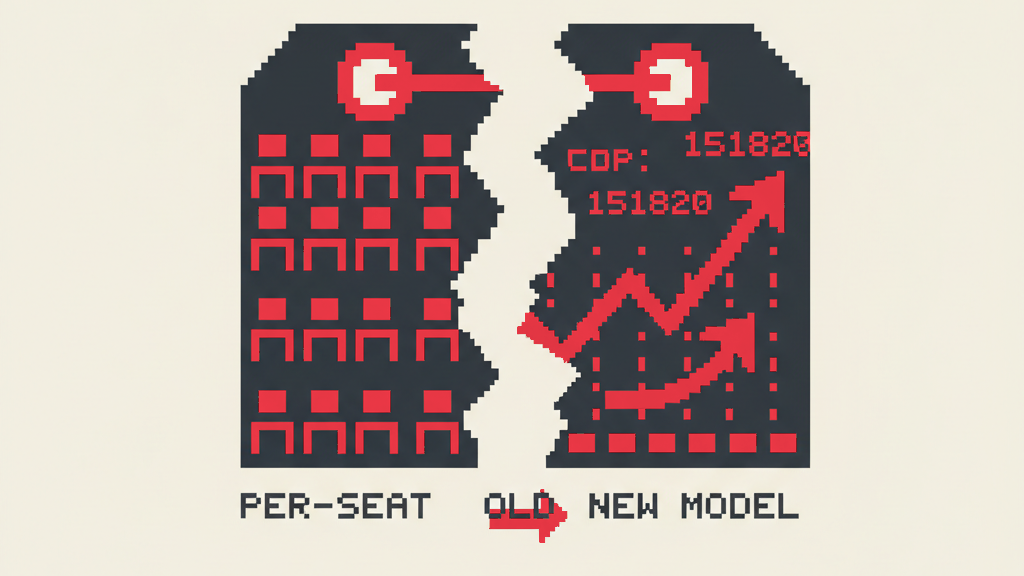
How much does your credit union pay for technology per employee? Now ask the follow-up: how much value does each of those technology seats actually produce?
If you can’t answer the second question — and most CFOs can’t — you’re paying for inputs, not outcomes. And the pricing model that built a $2 trillion SaaS industry is about to break.
In February 2026, agentic AI demos wiped roughly $285 billion off software market caps in weeks — what traders called the SaaSPocalypse. The selloff wasn’t because the companies were bad. It was because Wall Street realized something fundamental: if AI agents can do the work, why are we paying per human seat?
Meanwhile, Sierra AI — co-founded by Bret Taylor, the former co-CEO of Salesforce — hit $100 million in annual recurring revenue in 21 months. Not by selling seats. By charging per autonomously resolved customer conversation. If the AI resolves the issue, Sierra gets paid. If it escalates to a human, Sierra absorbs the cost. Their incentive is perfectly aligned: they only get paid when the problem actually gets solved.
Taylor’s warning to legacy vendors should keep every SaaS CEO up at night: “Closing a technology gap is hard but not impossible. Changing your business model is really hard.”
For credit unions — institutions with 30 to 200 employees where headcount is sacred — the shift from per-seat to per-outcome pricing isn’t just a cost optimization. It’s a structural advantage that legacy vendors literally cannot match without destroying their own revenue.
The Per-Seat Model Was Designed for a Human-Labor World
Per-seat pricing made sense when software amplified human workers. Salesforce pioneered the model around 1999-2000, and the logic was elegant: software makes each employee more productive, so charge per employee. More employees means more value delivered means more revenue. Everyone wins.
The model spread everywhere. CRM at $25-$300 per seat per month. Help desk at $15-$150. Compliance tools at $50-$200. Loan origination systems. Document management. Analytics. Every tool in your credit union’s technology stack charges per user.
But the model carries a hidden perverse incentive that AI exposes. Per-seat pricing means your vendor profits from more humans using their software, not from better outcomes. If AI reduces the number of humans who need to touch a workflow, the vendor’s revenue shrinks. The vendor’s financial interest is structurally opposed to your operational efficiency.
Consider a concrete example. A contact center platform charges $75-$125 per agent per month. When AI handles 60% of member inquiries autonomously, the vendor doesn’t celebrate your efficiency — they lose 60% of their seat revenue. The per-seat model literally shrinks as AI replaces human agents. This isn’t a feature the vendor wants to sell you.
Instead of rethinking the model, legacy vendors are bolting AI onto existing per-seat pricing as a premium tier. Microsoft Copilot: $30 per user per month on top of existing Microsoft 365 licenses. GitHub Copilot: $19-$39 per user per month. Salesforce Agentforce: initially launched at $2 per conversation but layered on top of existing per-seat CRM costs. You’re paying for the seat and paying extra for the AI that should be making the seat unnecessary.
As Taylor put it: “Paying for tokens consumed is like paying engineers per keystroke.” The cost of running the AI isn’t the value. The outcome is the value.
Three Eras of Software Pricing
We’re living through the third major pricing model shift in enterprise software — and each shift revealed who was actually creating value.
Era 1: Perpetual Licenses (1980s-2000s). Pay once, own forever. Oracle, SAP, Microsoft. Massive upfront costs — $500,000 to $5 million — with 18-month implementations and expensive maintenance contracts running 15-22% of the license fee annually. The customer bore all the risk. If the software didn’t work, you’d already paid.
Era 2: SaaS Subscriptions (2000s-2020s). Pay monthly per seat. Salesforce, Workday, ServiceNow. Lower upfront cost, faster deployment, and the vendor bears infrastructure risk. This was revolutionary because it shifted risk from buyer to seller. But the metric was still access, not outcome. You paid for the right to use the tool, regardless of whether it produced results.
Era 3: Outcome-Based Pricing (2024-present). Pay per result. Sierra charges per resolved conversation. Intercom’s Fin AI charges $0.99 per resolution. AI-native vendors are converging on models where revenue ties to value delivered — resolved inquiries, completed audits, hours saved — rather than seats occupied. The vendor only gets paid when the customer gets value. Risk shifts entirely to the vendor — which is why only AI-native companies can afford to offer it.
The historical parallels are striking — and credit union CFOs will recognize the pattern.
Advertising moved from CPM (pay per impression) to CPC (pay per click) to CPA (pay per acquisition). Each shift killed companies that couldn’t prove their value. Google’s CPC model destroyed print advertising because it proved what actually drove results.
Cloud computing moved from perpetual server licenses to AWS pay-per-use in 2006. Nobody buys servers anymore because paying for what you use is obviously better than paying for what you might need.
Insurance is moving from annual premiums to usage-based models — Progressive Snapshot, Tesla Insurance. When you can measure actual risk, flat-rate pricing looks absurd.
In every case, the companies that couldn’t transition to the new model didn’t just lose market share. They became structurally irrelevant.
Why Legacy CU Vendors Can’t Make the Switch
Jack Henry, Fiserv, and FIS aren’t just choosing not to offer outcome-based pricing. They structurally can’t.
The math makes this a structural problem, not a strategic one. Jack Henry generates $1.9 billion in revenue built on per-transaction pricing. Fiserv generates $18.5 billion built on per-account fees. Both companies carry cost structures supporting 40,000-plus employees each. Switching to outcome-based pricing would crater their revenue while the cost structure remains unchanged.
Clayton Christensen predicted exactly this in “The Innovator’s Dilemma” — incumbents can’t adopt disruptive pricing models because their existing business depends on the old model. Jack Henry can’t charge per resolved inquiry because their entire revenue engine depends on per-transaction fees across thousands of credit unions. Changing the model for one credit union means eventually changing it for all of them.
Vendor lock-in compounds the problem. Credit unions are locked into five-to-seven-year core contracts with deconversion fees that can run into the millions. Jack Henry collected $16 million in deconversion fees in FY2025 alone — the penalty for leaving, before you’ve spent a dollar on the new system. Credit unions can’t easily switch even when they see better pricing models available, and vendors have no competitive pressure to change.
IDC predicts that 70% of software vendors will experiment with or adopt non-seat-based pricing by 2028. The question isn’t whether it happens. It’s who moves first and who gets left behind.
Your credit union manages an estimated 50-plus vendor relationships and 30-40 active integrations. An estimated 80% of your IT budget goes to managing existing vendors, not building new capabilities. Every one of those per-seat contracts is a bet that human headcount stays constant. AI is about to break that bet.
What Outcome-Based Pricing Actually Looks Like
When you align the vendor’s revenue with your outcomes, everything changes.
Sierra’s model in detail: customers negotiate a per-resolution price upfront. AI resolves the issue autonomously? Sierra gets paid. AI can’t resolve it and escalates to a human? Sierra absorbs the cost — the customer pays nothing for the failed attempt. This creates a powerful incentive loop: Sierra is obsessed with resolution quality because their revenue depends on it.
Intercom’s Fin charges $0.99 per AI-resolved customer query. Simple, transparent, directly tied to value delivered. No seat licenses, no minimum commitments per resolution.
For credit unions, the economics are compelling. A typical credit union spends $15-$25 per member service call — labor, overhead, technology. If an AI agent resolves 80% of routine inquiries autonomously at $3-$5 per resolved inquiry, the credit union saves 75% or more on those interactions. The vendor earns more per unit than a flat subscription would yield. Both sides win.
Consider BSA/AML — an industry spending $23 billion annually with a 95% false positive rate. If AI triages alerts and resolves the false positives, charging per completed investigation makes the ROI self-evident. Your CFO can see “$12 per SAR investigation” versus “$125,000 per year for your current monitoring platform.” The comparison is instant. You stop debating “do we need this tool?” and start measuring “is this tool performing?”
Loan origination at $11,000 per loan — the MBA benchmark — includes enormous amounts of manual work that AI can handle: pre-screening, document collection, compliance checks. Outcome-based pricing means you pay proportionally to the work actually done, not for access to a system regardless of volume.
The compound effect is significant. A credit union currently spending $360,000-$910,000 per year across displaced vendor categories could move to $35,000-$50,000 per year — because you’re paying for outcomes, not access. The savings aren’t incremental. They’re structural.
The Credit Union Structural Advantage
Here’s where the cooperative model becomes a genuine competitive edge.
Seventy-two percent of credit unions have under $100 million in assets. Per-seat pricing is structurally regressive for these institutions. A 50-person credit union pays the same per-seat rate as a 5,000-person bank but gets dramatically less value because it can’t afford specialists for every function. The small credit union subsidizes the pricing model that was designed for enterprise scale.
Outcome-based pricing is the great equalizer. A $50 million credit union and a $2 billion credit union both pay per resolved inquiry, per completed audit, per processed loan. The small credit union gets the same AI capability at proportional cost. This is how cooperative economics should work.
The CUSO distribution model amplifies the advantage. When one CUSO integration serves hundreds of credit unions, the per-outcome cost drops for everyone. Volume discounts flow cooperatively — 15-25% at scale. This is Cooperative Principle #6 — cooperation among cooperatives — expressed as a pricing model.
At Runline, we’re building toward this model deliberately. Each Runner is priced based on its complexity, the workflows it handles, and the infrastructure it requires — not per seat. As we learn the cost curves alongside our credit union partners, we’ll evolve toward true outcome-based pricing. But even in the current model, each Runner delivers two to three FTEs in annual capacity — and the metric isn’t “FTEs replaced.” It’s “capacity unlocked.” Your 50-person credit union operates at the capability of a 150-person institution. Same people, dramatically more impact.
The legacy vendor trap is predictable. Jack Henry and Fiserv will eventually offer AI features — they have to. But they’ll bolt them onto per-seat pricing because they can’t afford to cannibalize their existing revenue. You’ll pay for the seat and the AI. Outcome-native vendors charge only for value delivered. The pricing gap is structural because the incumbents’ entire business depends on the old model surviving.
The Vendor You Want Is the One That Only Gets Paid When You Win
Circle back to the opening question: how much value does each technology seat produce? With outcome-based pricing, you never have to guess. The answer is in every invoice.
Credit unions that move to outcome-based AI pricing first will operate at fundamentally different unit economics than those still paying per seat. A 50-person credit union operating at 200-person capability at proportional cost isn’t just more efficient — it’s a different category of institution.
The SaaSPocalypse I described in Article 4 diagnosed the disruption. This article prescribes the response. The technology gap between legacy vendors and AI-native platforms will close — it always does. The pricing model gap won’t, because incumbents can’t cannibalize their own revenue to match it.
The credit unions that thrive in the AI era won’t just adopt better technology. They’ll adopt better economics. And the economics of outcomes always beat the economics of seats — because outcomes are what your members actually care about.
Sean Hsieh is the Founder & CEO of Runline, the secure agentic platform for credit unions. Previously, he co-founded Flowroute (acquired by Intrado, 2018) and Concreit, an SEC-regulated WealthTech platform managing real securities under dual federal regulatory frameworks.
Next in the series: “The Agentic Workforce: What Credit Unions Look Like When Every Employee Has an AI Team” — when pricing is outcome-based and AI agents have zero marginal seat cost, what does a 50-person credit union operating at 200-person capability actually look like?