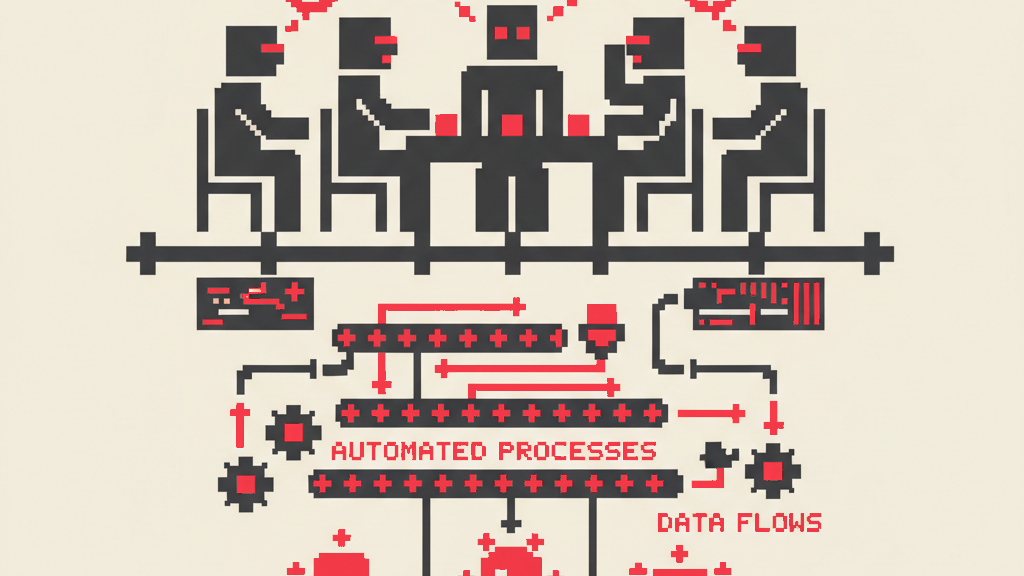
Picture this. A 75-person credit union in Ohio pays a CUSO $85 per BSA alert review. The CUSO’s compliance team — experienced, competent, trusted — processes 300 alerts a month for them. That’s $25,500 a month, $306,000 a year. The credit union’s board approved this years ago. The budget line is in the general ledger. The acceptance that this work can be done externally is baked into how the institution operates.
Now imagine an AI Runner doing the same work — triaging alerts, drafting tracker notes, preparing SAR narratives for human review — at $8,500 a month. One-third the cost. Faster turnaround. Better audit trails. Every decision logged, every alert disposition documented, every SAR narrative version-controlled.
The credit union doesn’t need to fire anyone. They don’t need to restructure a department. They don’t need a change management consultant. They swap a vendor. Same budget line, same procurement process, same board approval category. The only thing that changes is the line item description.
That’s the outsourcing wedge. And it’s the most underappreciated distribution strategy in AI.
The Sequoia Framework
Sequoia Capital recently published an analysis — written by Julien Bek, 646,000 impressions and counting — that argued the next trillion-dollar company will be “a software company masquerading as a services firm.” The core thesis: for every dollar spent on software, six dollars are spent on services. AI doesn’t replace software. It replaces the services layer.
Bek drew a critical distinction between intelligence work and judgment work. Intelligence is rules-based, pattern-matching, data-gathering — the kind of work that AI handles well today. Judgment requires experience, taste, relationship context, institutional values. AI handles intelligence. Humans handle judgment.
Then he identified the wedge: if a task is already outsourced, three things are true. First, the company has accepted that the work can be done externally. Second, a budget line already exists. Third, the buyer already purchases outcomes, not labor hours. Replacing an outsourcing contract with an AI-native service is a vendor swap. Replacing headcount is a reorg.
Vendor swap beats reorg. Every time.
Bek mapped this across verticals — insurance brokerage at $140-200 billion, accounting at $50-80 billion, healthcare revenue cycle management at $50-80 billion, IT managed services at $100 billion-plus, recruitment at $200 billion-plus. Each vertical has massive outsourcing spend, intelligence-heavy workflows, and existing buyer acceptance of external execution.
He didn’t map credit unions. Let me.
The Credit Union Outsourcing Map
Credit unions outsource more than most people realize. The CUSO model — Credit Union Service Organizations, which I covered in Article 13 — exists precisely because individual credit unions are too small to build every capability in-house. Over 1,000 registered CUSOs serve the industry, from Velera at $1.48 billion in revenue to specialized compliance, lending, and technology shops.
I’ve seen this ecosystem from the inside. At one CUSO partner, the SOPs were “sprinkled across people’s computers, tribal knowledge in people’s heads.” Their BSA analysts were running at 125% capacity, averaging 60-hour weeks, serving dozens of credit unions. The outsourcing model worked — barely. The analysts were drowning, but the credit unions they served couldn’t afford to hire internally at that expertise level. That’s the fundamental tension the CUSO model solves. And it’s the exact tension AI was built to relieve.
Here’s what’s commonly outsourced, and how each maps to the Sequoia framework:
BSA and Compliance Reviews. Many credit unions outsource alert monitoring, SAR preparation, and exam readiness to compliance CUSOs or third-party firms. A typical engagement runs $200,000-$400,000 annually for a mid-size institution. The work is 90-95% intelligence — pattern matching against rules, data gathering across systems, template-based documentation. I described the 95% false positive rate in Article 6: your compliance vendor’s analysts are spending the vast majority of their time clearing alerts that turn out to be nothing, just like your in-house team would. An AI Runner does the intelligence layer at a fraction of the cost, with the human analyst — whether in-house or at the CUSO — focusing on the 5% that requires actual investigative judgment.
Loan Servicing. Third-party servicers handle payment processing, escrow management, investor reporting, and delinquency tracking for credit unions that lack the scale to do it efficiently in-house. The work is heavily procedural — 85% intelligence, following documented rules and regulatory requirements. The judgment layer is thin: exception handling, workout decisions, and member relationship calls that require context no algorithm has.
Collections. Outsourced collections is a mature market. Credit unions send delinquent accounts to third-party agencies that research payment history, run skip traces, make calls, and negotiate payment plans. In Article 7, I mapped collections at a single CUSO: agents spending 5-10 minutes researching each member before every call, 320 calls per week, 1,820 hours per year in manual research alone. An AI Runner pre-screens member history, drafts call briefs, and suggests negotiation parameters. The collections agent — whether at a CUSO or a third party — handles the conversation. The research is intelligence. The negotiation is judgment.
IT Support and Managed Services. Small credit unions with 3-15 person IT teams outsource helpdesk, patching, monitoring, and provisioning to managed service providers. The intelligence ratio is high — 90% of IT support is procedural. Patching is a checklist. Monitoring is pattern detection. Provisioning is template execution. The judgment calls — architecture decisions, vendor evaluation, security incident response — are the 10% that require a human who understands the institution.
HR Services. Employment verifications, benefits administration, payroll processing, onboarding document routing. At Heartland, I watched Kari processing five to ten employment verifications per week at 15-30 minutes each — pull the records, validate the data, generate the letter, send it off. Many credit unions outsource pieces of HR to PEOs or shared service providers. The work is almost entirely intelligence — form completion, document routing, data entry, compliance checking.
Every one of these categories has existing budget, existing acceptance of external execution, and a high intelligence-to-judgment ratio. They’re textbook outsourcing wedges.
Why Vendor Swap Beats Reorg
The Sequoia insight that resonated most with me — because I’ve watched it play out at every credit union I’ve embedded with — is the asymmetry between replacing a vendor and replacing a person.
Replacing a vendor is a procurement decision. You evaluate alternatives, negotiate terms, set a transition timeline, and switch. Your CFO signs off. Your board reviews it during the regular vendor management cycle. The process exists. The muscle memory exists. Credit unions do this every time they switch a core processor, a card provider, or a compliance monitoring tool.
Replacing a person — or even augmenting a person’s role with AI — is a human resources decision. It requires change management. It triggers fear. Your BSA officer wonders if she’s next. Your lending team worries about job security. Your board asks whether “AI replacing employees” aligns with the credit union’s people-first mission. Even when the intent is augmentation, not replacement, the perception problem is real.
I’ve seen this dynamic firsthand. At one credit union partner, the compliance team was operating at 125% capacity, averaging 60-hour weeks. They needed help desperately. But when the conversation turned to AI handling some of their workload, the immediate reaction was anxiety, not relief. “Are you trying to replace us?” No — we’re trying to stop you from burning out. But the emotional response doesn’t follow the logical argument.
Here’s my contrarian take: the outsourcing wedge isn’t just cheaper — it’s more humane. It sidesteps the entire problem. You’re not touching anyone’s job. You’re replacing a vendor with a better vendor. The compliance work that was already being done externally continues to be done externally — just faster, cheaper, and with better documentation. Your in-house team isn’t affected. If anything, they benefit: the AI service produces cleaner handoffs, better audit trails, and more consistent output than the previous vendor.
Once the AI service proves itself on outsourced work — once the institution sees the quality, the cost savings, the audit trail — the conversation about applying the same technology to in-house workflows becomes natural. Not threatening. Natural. “If the AI Runner is doing our outsourced BSA triage this well, could it help our in-house team with the same work?” That question comes from the team, not from management. That’s adoption. That’s trust.
The CUSO Amplifier
In Article 13, I described the cooperative distribution advantage: when one CUSO validates and integrates a technology, hundreds of credit unions inherit it. The outsourcing wedge makes this distribution model even more powerful.
Here’s why. A CUSO that provides outsourced compliance services to 300 credit unions is the perfect first customer for an AI-native compliance service. The CUSO already does the work. The CUSO already has the budget. The CUSO already accepts that the work is procedural and can be systematized. If the AI Runner can do the intelligence layer of compliance triage — and the CUSO’s human analysts can focus on the judgment layer — the CUSO becomes more profitable, more scalable, and more competitive.
The CUSO doesn’t just adopt the AI. The CUSO becomes the AI-native service provider. And when it does, every credit union in the CUSO’s network gets access to AI-powered compliance — not as a scary new technology they need to evaluate independently, but as an upgrade to a service they already buy from a vendor they already trust.
I built Flowroute on this same insight — we didn’t sell telecom infrastructure directly to every end customer. We sold through carriers and platforms that already had the relationships. Infrastructure outlasts products, and distribution through trusted networks outlasts direct sales every time. The CUSO model is the credit union equivalent.
This is the cooperative flywheel I described in Article 13 applied to the outsourcing wedge. One CUSO integration. Three hundred credit unions served. The trust network does the selling. No cold outreach. No board-level AI anxiety. Just a vendor delivering better results at lower cost through a channel that already exists.
The math scales. If a CUSO serves 300 credit unions at an average of $15,000-$25,000 per year for AI-augmented compliance services, that’s $4.5-$7.5 million in annual revenue from a single CUSO relationship — before expanding to lending, collections, HR, or any other outsourced function. Scale across multiple CUSOs and core processor networks — Symitar’s 535-700 credit unions, Fiserv’s 1,150-plus, Corelation’s 145-plus — and the addressable market reaches thousands of institutions through cooperative distribution alone.
The $1-to-$6 Ratio in Credit Unions
Bek’s Sequoia analysis cited a striking ratio: for every dollar enterprises spend on software, they spend six dollars on services and labor. The opportunity for AI isn’t in replacing the software dollar. It’s in compressing the six service dollars.
Credit unions fit this pattern precisely — arguably more so than most industries. A mid-size credit union might spend $500,000-$2 million annually on technology: core processor, LOS, CRM, compliance monitoring, digital banking platform. But the same institution spends $3-$12 million on compensation and benefits for the staff who operate those systems. Add outsourced services — compliance reviews, collections, IT support, loan servicing — and the ratio climbs higher.
The technology spend is already optimized. Credit unions have been negotiating core processor contracts for decades. The service and labor spend is where the compression opportunity lives. Not by eliminating people — by automating the intelligence work that consumes 80% of their time, whether that work is performed in-house or outsourced.
In Article 7, I mapped 6,500 hours per year of automatable work across four departments at a single CUSO — BSA (1,560 hours), collections (1,820 hours), product management (2,860 hours), HR (260 hours). At conservative labor rates, that’s $329,000 in direct value. At 10x scale across a CUSO’s network, $3.29 million. That’s not software savings. That’s services compression — exactly the Sequoia thesis, applied to credit unions.
The Expansion Path
The outsourcing wedge isn’t a destination. It’s a beachhead.
Start with what’s already external. BSA reviews outsourced to a compliance CUSO. Collections sent to a third-party agency. IT support from a managed service provider. These are the easiest wins because they require no internal change management, no FTE displacement anxiety, no organizational restructuring. You’re improving a vendor relationship, not disrupting a department.
Expand to what’s internal once trust is built. When your team sees that the AI Runner produces cleaner BSA triage than the outsourced vendor — and your examiners agree — the conversation about using the same technology in-house becomes a request, not a mandate. When your collections team sees the AI-generated call briefs and asks “can we get that for our in-house accounts too?” — that’s organic adoption driven by demonstrated value.
At Runline, we see this pattern in our own operations. We started by deploying our agents on internal intelligence work — research, document assembly, competitive analysis. Once we saw the quality, we expanded to progressively higher-stakes workflows. Same progression. Same trust-building. We eat our own cooking before serving it to anyone else.
The progression mirrors the trust tiers I described in Article 12. Training wheels on outsourced work — low risk, high visibility. Supervised on the first internal workflows. Semi-autonomous as the institution builds confidence. The outsourcing wedge gives you the runway to build trust without betting the organization.
Bek called this pattern “the outsourcing wedge into the insourcing expansion.” I’d put it differently for credit unions: start where the budget is, expand where the impact is.
The Next Trillion-Dollar Company Won’t Sell Software
Bek’s boldest claim — that the next trillion-dollar company will be a software company masquerading as a services firm — has specific implications for credit unions.
The vendors that will win credit union business in the next five years won’t sell seats, licenses, or platforms. They’ll deploy agents that resolve compliance alerts, process loan documentation, handle member inquiries, and generate audit trails. The pricing will evolve — starting with agent-based models that reflect complexity and infrastructure, and gradually shifting toward true outcome-based pricing as the industry learns what “outcome” means for agents that grow with the institution. What won’t change is the direction: away from per-seat, toward value delivered.
And the distribution channel for those outcomes won’t be enterprise sales teams. It’ll be CUSOs — the cooperative infrastructure that already distributes outsourced services to hundreds of credit unions simultaneously.
The credit unions that move first won’t be the ones with the biggest technology budgets. They’ll be the ones that recognize what they’re already doing — outsourcing intelligence work to external providers — and upgrade the provider. Same budget line. Same procurement process. Better results.
The outsourcing wedge isn’t a technology strategy. It’s a procurement strategy that happens to involve AI. And for credit unions, procurement strategies are a lot easier to approve than technology transformations.
Your CUSO already does the work. Your board already approved the budget. The only question is whether the next vendor on that budget line is a room full of analysts — or a Runner that never sleeps, never forgets, and logs every decision for your examiner.
Sean Hsieh is the Founder & CEO of Runline, the secure agentic platform for credit unions. Previously, he co-founded Flowroute (acquired by Intrado, 2018) and Concreit, an SEC-regulated WealthTech platform managing real securities under dual federal regulatory frameworks.
Next in the series: “Intelligence Work vs. Judgment Calls” — every credit union department has an intelligence-to-judgment ratio. Map it, and you know exactly where AI delivers ROI on day one.